Karnaugh Maps
The Karnaugh map provides a simple and straight-forward method of minimising boolean expressions. With the Karnaugh map Boolean expressions having up to four and even six variables can be simplified.
what is a Karnaugh map?
A Karnaugh map provides a pictorial method of grouping together expressions with common factors and therefore eliminating unwanted variables. The Karnaugh map can also be described as a special arrangement of a truth table.
The diagram below illustrates the correspondence between the Karnaugh map and the truth table for the general case of a two variable problem.

The values inside the squares are copied from the output column of the truth table, therefore there is one square in the map for every row in the truth table. Around the edge of the Karnaugh map are the values of the two input variable. A is along the top and B is down the left hand side. The diagram below explains this:A Karnaugh map provides a pictorial method of grouping together expressions with common factors and therefore eliminating unwanted variables. The Karnaugh map can also be described as a special arrangement of a truth table.

Karnaugh Maps - Rules of Simplification
The Karnaugh map uses the following rules for the simplification of expressions by grouping together adjacent cells containing ones
- Groups may not include any cell containing a zero
- Groups may be horizontal or vertical, but not diagonal.
- Groups must contain 1, 2, 4, 8, or in general 2n cells.
That is if n = 1, a group will contain two 1's since 21 = 2.
If n = 2, a group will contain four 1's since 22 = 4. - Each group should be as large as possible.
- Each cell containing a one must be in at least one group.
- Groups may overlap.
- Groups may wrap around the table. The leftmost cell in a row may be grouped with the rightmost cell and the top cell in a column may be grouped with the bottom cell.
- There should be as few groups as possible, as long as this does not contradict any of the previous rules.


2 variable K– map
2 variable K– map plot below : -


Minimization solution to above function.
=xy'+x'y'+xy+xy'
= y’(x + x’) + xy + xy’
= y’ + x (y+y’)
= y’ + x
so the answer is = y’ + x
 + AB
+ AB
Problem 2:
Consider the expression Z = f(A,B) =
 + A + B plotted on the Karnaugh map:
The simplified answer is Z =
+ 3 variable Karnaugh map
The K-
minimized logic.
Example: Minimize following 3 var function.

Above is a common format of representing the K-

Three variable K– map with 1 and 0 values assigned to cells is shown in next table.

F = x’y’(z+z’) + xy(z+z’)
= x’y’ + xy (Answer.)
Problem 1: Z = f(A,B,C) =  + B + AB + AC
+ B + AB + AC
The minimised result obtained is B + AC+
Problem 2: Z = f(A,B,C) = B + B + BC + A
The minimized result obtained is B + A
4 -
MINIMIZATION USING FOUR VARIABLE KARNAUGH MAP

B + B + BC + AThe minimized result obtained is B + A
More practice examples on 3 var kmap completely solved at following links.
completely solved at following links.
4 -variable Karnaugh map (K-map)
K-
Note: The columns and rows which are interchanged (not is sequence) are correct and part of kmap plots.

K-
Note: The columns and rows which are interchanged (not is sequence) are correct and part of kmap plots.
MINIMIZATION USING FOUR VARIABLE KARNAUGH MAP
f1=(x'y'z'w'+x'yz'w')+(x'y'zw'+x'yzw')
=x'z'w'+x'zw'
=x'w'
f2=(x'yz'w'+xyz'w')+(x'yzw'+xyzw')
=yz'w'+yzw'
=yw'
F=f1+f2
The Minimized Value of F = x’w’ + yw’
Four variables K-map (truth table and K-map plot).
- F(x,y,w, z) = (0,1,2,3,4,6,11,14)
- F(x,y,w, z) = (0,2,4,6,12,14)
- F(x,y,w, z) = (0,2,5,7,8,11,13,15)
Don’t Care (X) Conditions in K-Maps
A standard SOP function having don’t cares can be converted into a POS expression by keeping don’t cares as they are, and writing the missing minterms of the SOP form as the maxterm of POS form.
Similarly, a POS function having don’t cares can be converted to SOP form keeping the don’t cares as they are and write the missing maxterms of the POS expression as the minterms of SOP expression.
Example-1:
Minimise the following function in SOP minimal form using K-Maps:
f = m(1, 5, 6, 12, 13, 14) + d(4)
Explanation:
The SOP K-map for the given expression is:
 Therefore, SOP minimal is,
f = BC' + BD' + A'C'D
The “Don’t Care” conditions allow us to replace the empty cell of a K-Map to form a grouping of the variables.
we can consider a “Don’t Care” cell as either 1 or 0 or we can simply ignore that cell. Therefore, “Don’t Care” condition can help us to form a larger group of cells.
A Don’t Care cell can be represented by a cross(X) in K-Maps representing a invalid combination.
For example, in Excess-3 code system, the states 0000, 0001, 0010, 1101, 1110 and 1111 are invalid or unspecified. These are called don’t cares.
A standard SOP function having don’t cares can be converted into a POS expression by keeping don’t cares as they are, and writing the missing minterms of the SOP form as the maxterm of POS form.
Similarly, a POS function having don’t cares can be converted to SOP form keeping the don’t cares as they are and write the missing maxterms of the POS expression as the minterms of SOP expression.
Example-1:
Minimise the following function in SOP minimal form using K-Maps:
Minimise the following function in SOP minimal form using K-Maps:
f = m(1, 5, 6, 12, 13, 14) + d(4)
Explanation:
The SOP K-map for the given expression is:
The SOP K-map for the given expression is:
Therefore, SOP minimal is,
f = BC' + BD' + A'C'D
Example-2:
Writing the given expression in POS form:
F(A, B, C, D) = M(6, 7, 8, 9) + d(10, 11, 12, 13, 14, 15)

F = A'(B' + C')
K-maps for Sum-of-Product Design
Sum Of Product (SOP)
-
Sum of Product is the abbreviated form of SOP. Sum of product form is a form of expression in Boolean algebra in which different product terms of inputs are being summed together. This product is not arithmetical multiply but it is Boolean logical AND and the Sum is Boolean logical OR.
Sum of Product is the abbreviated form of SOP. Sum of product form is a form of expression in Boolean algebra in which different product terms of inputs are being summed together. This product is not arithmetical multiply but it is Boolean logical AND and the Sum is Boolean logical OR.
To understand better about SOP, we need to know about min term.
Min Term
-
Minterm means the term that is true for a minimum number of combination of inputs. That is true for only one combination of inputs.

Examples:
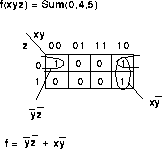
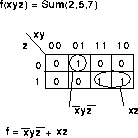
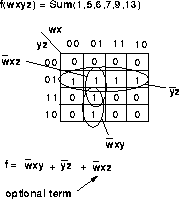
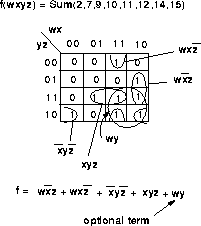
Minterm means the term that is true for a minimum number of combination of inputs. That is true for only one combination of inputs.
Since AND gate also gives True only when all of its inputs are true so we can say min terms are AND of input combinations like in the table given below.
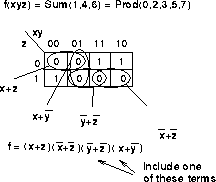
K-maps for Product-of-Sum Design
Product of Sum
Product of Sum abbreviated for POS.
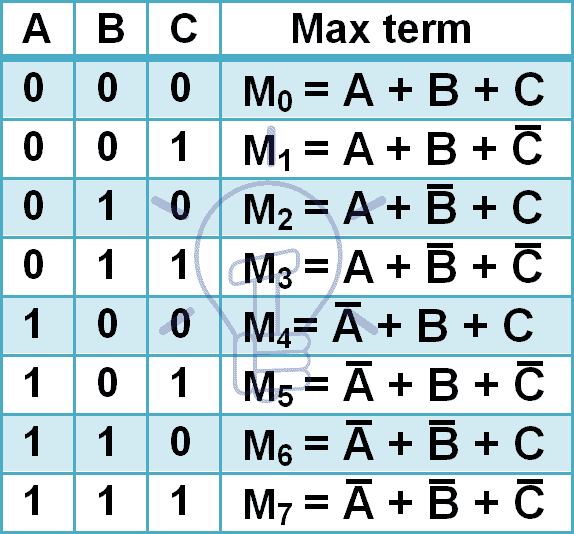
Max Term
Maxterm means the term or expression that is true for a maximum number of input combinations or that is false for only one combination of inputs.
Designing with Don't-Care Values
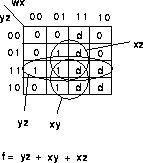
In some situations, we don't care about the value of a logic function.
For example, if we use wxyz to represent a number from 0 to 9, we need not worry about the function value produced for wxyz = 10...15.
For these situations, the function can be assigned an output in order to make the resulting circuit as simple as possible.
Suppose we wish to implement the function- f(wxyz)=Sum(3,5,6,7)
and we have the don't-care condition of - d=Sum(10,11,12,13,14,15).The sum-of-products implementation:
The product-of-sums implementation:
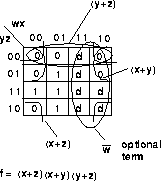
For example, if we use wxyz to represent a number from 0 to 9, we need not worry about the function value produced for wxyz = 10...15.
For these situations, the function can be assigned an output in order to make the resulting circuit as simple as possible.
Suppose we wish to implement the function
and we have the don't-care condition of

No comments:
Post a Comment